
Distributed acoustic sensors, cable-connected to a local processing unit, the EKHO Core, which identifies the threat and alerts a supervision console, without relying on a radio signal or a cloud connection.
Each EKHO sensor carries a microphone array in continuous passive listening. Several sensors are positioned around the perimeter of the site to be monitored, covering the whole area instead of a single observation point.
Captured signals are processed locally, on the EKHO Core, using signal-processing techniques and classification models that separate a drone's signature from ambient noise. Detection latency is 2 to 5 seconds.
| Environment | Range | Limiting factor |
|---|---|---|
| Rural, low noise | 120 – 150 m | Wind, wildlife |
| Suburban | 80 – 110 m | Traffic, human activity |
| Noisy industrial site | 60 – 90 m | Machinery, ventilation |
When several sensors detect the same source, comparing their observations estimates the origin of an acoustic signature through triangulation, producing a direction, an azimuth, rather than a simple binary alert.

Sensors report to the EKHO Core over a wired RJ45 Ethernet connection. The EKHO Core in turn reports to the supervision console over the site's local network (LAN). Every link in this chain stays on the customer's own infrastructure.
Analysis happens on site, on the EKHO Core unit cable-connected to the sensors. No cloud, no Wi-Fi and no internet connection are required for the detection function: a deliberate architectural choice built around edge processing, for data sovereignty and simpler deployment on sensitive sites.
Beyond the sensor itself, the architecture is designed to transmit only the information needed for detection and localisation (alerts, azimuth, signatures) rather than continuous raw audio, in line with a local-processing, network-frugal approach.

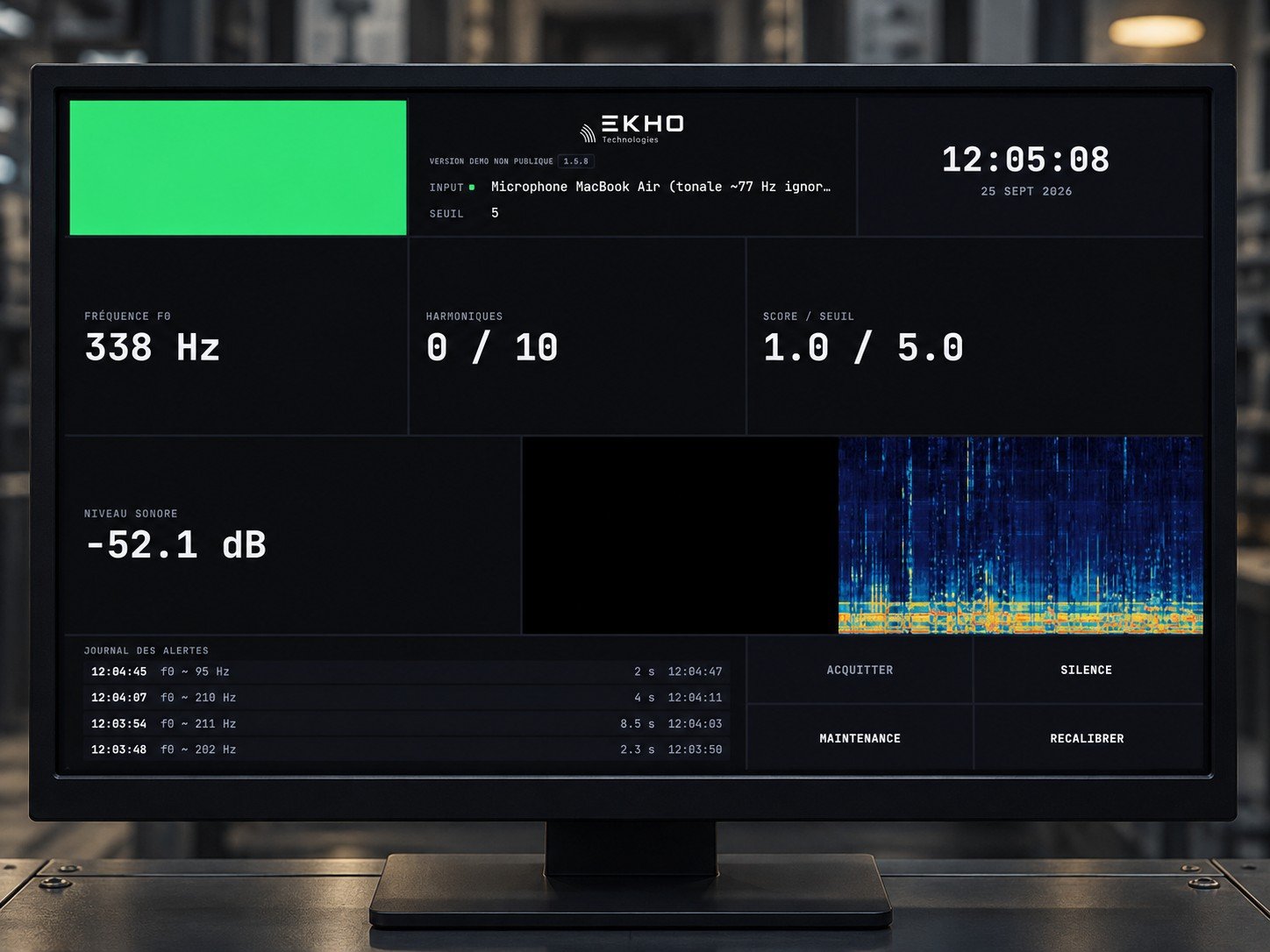
The principle of acoustic detection, explained in detail.
Learn more about acoustic drone detection →